Induction furnace refractory clay:
Refractory and refractory walls can be in the form of prefabricated crucibles or poundable masses, which are more widely used in the steelmaking industry. These poundable masses, which are also called induction furnace refractory clay, are selected according to the furnace capacity, furnace temperature, and type of furnace melt.
Induction furnace refractory clay should generally have the following characteristics:
Be easy to install
Have high density and uniformity after pounding
Have minimal separation in grain size and layering after pounding
Have low sintering time
Do not require high superheat
Have high temperature resistance
Have minimal dimensional changes due to shrinkage and expansion
Have desirable resistance to molten and corrosive agents
Have low thermal conductivity
Resistance to mechanical forces resulting from scrap flux and slag removal and molten discharge operations
Have good destructibility.
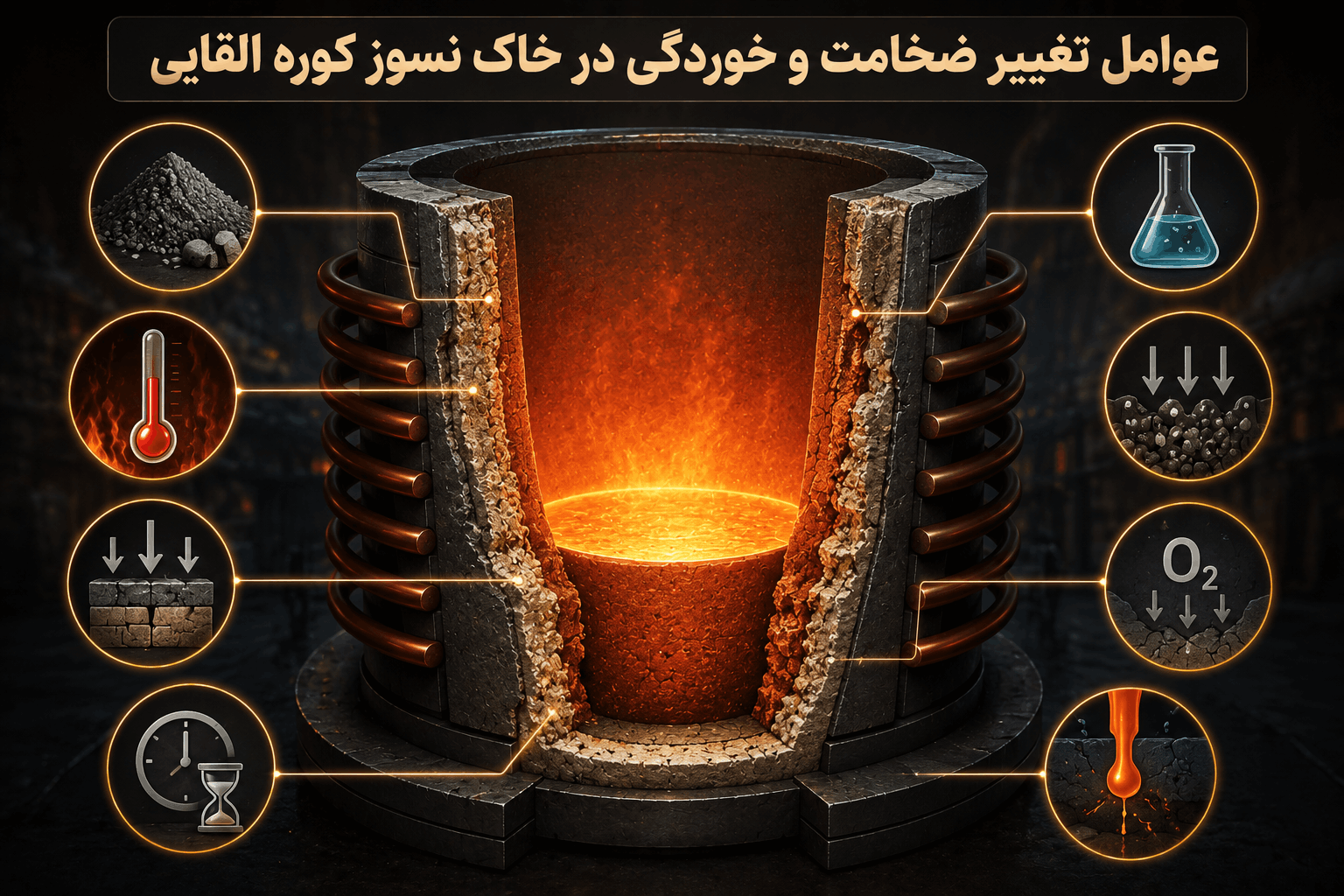
Below we describe the types of corrosion of refractory soils:
Corrosion due to granulation:
It is better to pour the refractory soil from the induction furnace into a tray and mix it thoroughly before compacting. Increasing the time of compacting with a vibrator is another cause of the separation of the silica particles in the soil. Separation causes a decrease in the density and resistance of the wall in the larger grains, as well as melt penetration in the finer-grained parts, lower strength, and a decrease in the sintering point due to enrichment with boric acid.
Corrosion due to molten penetration:
Sometimes molten penetration into the cracks causes corrosion. Failure to perform the compacting operation correctly, undesirable granulation and granulation separation, low boric acid content, and low melt temperature during sintering, resulting in improper wall baking and low strength.
Corrosion due to high temperature:
A- If the temperature exceeds a certain limit (C○ 1460), the carbon in the melt causes the reduction of the silica in the wall and causes the wall to corrode.
B) Another reason is the formation and increase in the amount of slag, which causes the wall to corrode.
Problems with deposition:
Sometimes, after the destruction of the refractory clay of the induction furnace, it is observed that in some areas of the refractory clay, especially near the asbestos, it has turned black or gray. This is due to two factors. First, carbon deposition can be caused by the decomposition of carbon monoxide gas that has penetrated from the wall towards the coil, and the separation of carbon and its deposition on the grains of the wall causes the color of the refractory clay of the wall to change.
Second, the unsuitability and decomposition of the asbestos components can cause carbon deposition on the refractory clay of the wall and cause its color to change.
Corrosion caused by impurities in the refractory soil of the induction furnace:
The presence of impurities in the soil during beating or the impact of the tip of the hammer with the asbestos of the wall and its tearing and mixing with the mass being beaten all cause the penetration of the melt and reduce the life of the wall.
Thickening of the wall:
Slag sticking to the wall and thickening of the wall, which reduces the capacity of the furnace and the melting efficiency. The use of sand-filled return (O3 AL2) from magnesite and (SIO2) from casting sand and the use of high-silicon scrap and the formation of mullite (3AL2O3.2SIO2) inside the melt, and this is in a case where there is significant alumina in the melt, which is due to the use of scrap with high aluminum. Iron oxide is also one of the reasons for the formation of sticky slag (use of oxidized chips and shavings).
Slag corrosion:
Basic slags cause corrosion of the acidic wall. Basic slags contain calcium carbide, lime, iron oxide, and manganese oxide.
Corrosion caused by molten materials:
A number of alloying elements cause corrosion of the wall due to interactions with the acidic wall. Lead, manganese, and titanium are among those elements.
Corrosion due to thermal shock:
Successive and rapid heating and cooling cause cracks in the refractory soil of the induction furnace.
Mechanical corrosion:
Inaccuracy in charging and impacts caused by this operation cause the wall and bottom of the furnace to peel off.
Methods for measuring erosion and corrosion:
Visual inspection, physical measurement, electrical measurement, use of thermocouples, and measurement of coil water temperature.
In this article below, you can learn about the types of refractory materials for the walls of induction furnaces.