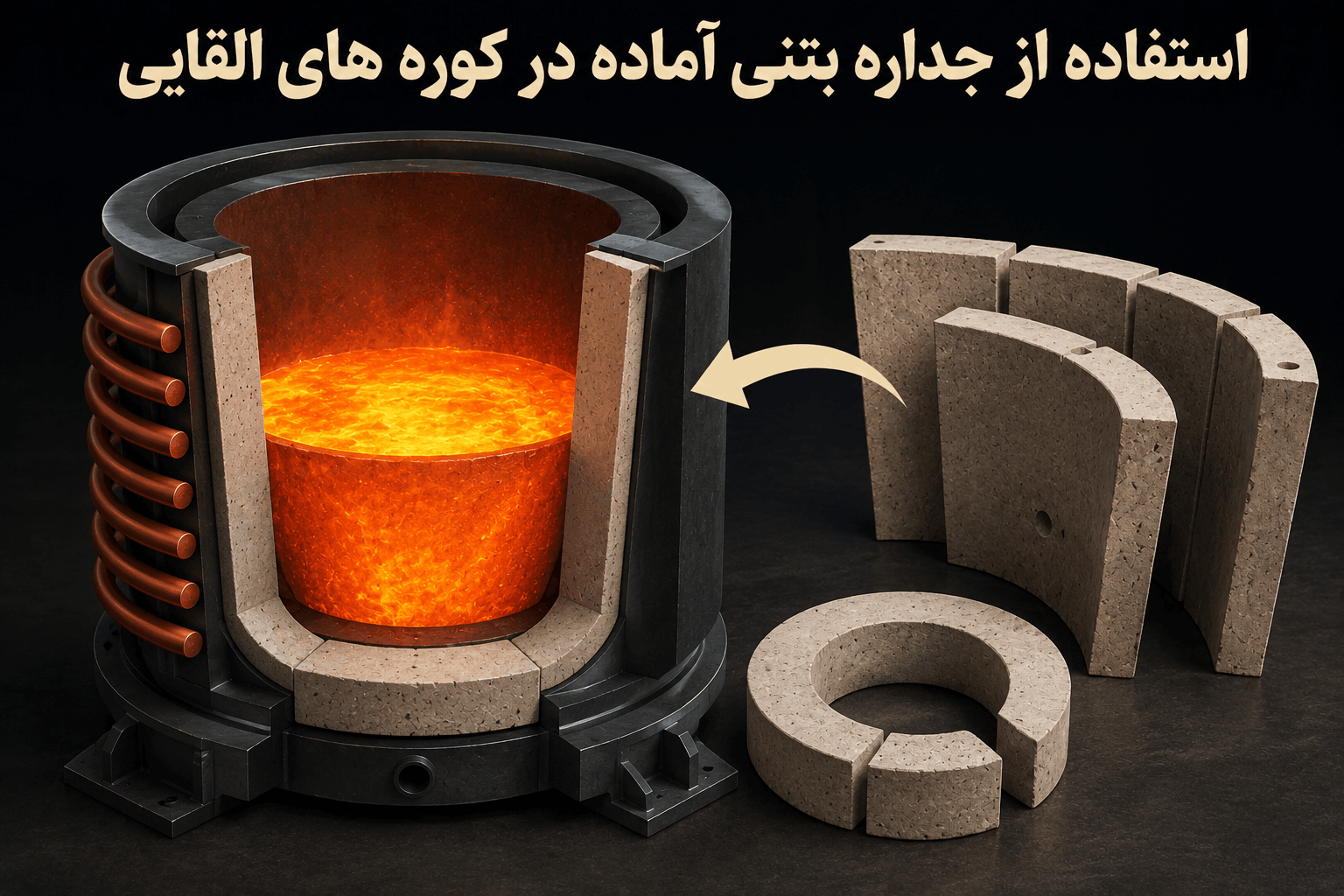
Use of ready-made concrete walls in induction furnaces
In the refractory walls of induction furnaces, ready-made alumina or magnesite concretes can also be used. However, the use of these types of concrete has certain conditions. Below we will explain how to use concrete in induction furnaces and concrete walls:
Choosing the type of concrete:
Magnesite concretes are also resistant to alkaline conditions, that is, if the nature of the melt used is alkaline, only magnesite concretes can be used for the furnace walls. However, if the nature of the melt is acidic, in addition to magnesite concretes, alumina concretes can be used. The weight percentage of MgO in magnesite concretes should be above 60% and the remaining 40% should be magnesite or alumina or reactive zirconia grains. Similarly, in alumina concretes, the Al2O3 content should be above 60% and the remaining 40% should be reactive alumina, magnesite or zirconia grains.
The use of concrete in the walls of induction furnaces poses an important problem, which is the very high shock susceptibility of these concretes. That is, during cooling and heating of the furnace, cracks may form in the sintered part of the wall, and these cracks may spread throughout the entire thickness of the concrete, causing the melt to penetrate towards the coil.
In this case, alumina concretes perform better than magnesite concretes. Because after cooling and reheating, they have reversible phases to reduce and close the crack, but magnesite concretes do not have this reversible ability. However, to deal with this problem, unsintered refractory soil can be pounded behind the magnesite or alumina block to an extent of at least half the thickness of the entire piece. So that after the melting passes through the concrete block, it stops in the unsintered soil and thus prevents damage to the coil.
How to use concrete in the walls of induction furnaces:
After selecting the type of concrete according to the type of melting produced, we mix it with a certain percentage of water and pour the concrete in the desired template outside the furnace. It should be noted that during the pouring of the concrete, the concrete is raked regularly to remove trapped air bubbles.
Then, after the initial hardening or setting of the hydraulic bond, we cover the entire assembly with plastic to prevent rapid water leakage and cracking of the concrete. Then, we open the template and dry the concrete block at a temperature of 110 degrees Celsius. Drying should also be done slowly to prevent cracks. Then, we place the block in the desired furnace and ram its back onto the soil coil until the concrete is on the soil.
After completing the above steps, it is time for the main baking of the block, which is done using the starter block and the furnace’s electric power. We perform the refractory concrete firing cycle according to the manufacturer’s instructions. The final sinter temperature must be at least 50 to 100 degrees above the applicable melting temperature. Then the concrete wall of the induction furnace is ready for charging.